So, a few days ago the Maxon AD-80 showed up in my mailbox, along with the DOD 280 pedal. Here are the real pictures:
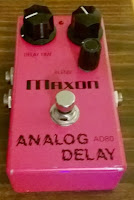
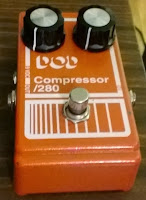
Both in pretty good condition, and not too shabby at $65 shipped.
Unfortunately, the Maxon didn't work correctly out of the box. There are 2 output jacks, see here:
(ignore the chunky fingers.)
See how one jack has the word "amplifier" and the word "dry" by it? Yeah, that's messed up. Truth be told, what it is trying to say is that the right jack is fully dry, and if you use both jacks into separate amps, it'll put the dry signal in one jack and the wet signal in the other, but if you just plug in to the left jack, you'll get the wet and dry signal. Get it? Got it. I made that mistake and thought it wasn't working at all. Moving on...
Plugged into the right jack, I could see what the seller was saying about it being out of whack. After all, I would turn the blend knob and barely get any delayed signal. But here's the big giveaway:
It crackled when I turned the knob.
Any experienced pedal tech knows what the crackle means. And it comes down to the mechanics of the potentiometer that the knob turns.
A potentiometer is basically a variable resistor that is controlled by a small metallic sweeper that moves with the potentiometer's shaft (which is then connected to the knob), which increases the distance from a static metallic sweeper to the mobile sweeper, hence increasing the distance and therefore the resistance. Ok, with me so far? Good.
Over time, especially when the knobs are not regularly turned, the inside of the potentiometer oxidizes, gets dirty, and whatever else, causing the connection between the mobile sweeper and the pad controlling the amount of resistance to go bad. In most cases, it just kills the connection entirely, effectively "turning off a switch" between the 2 lugs of the potentiometer (or 3, but that'll be covered later). Sometimes, the connection is so weak that it has its own resistance or doesn't send the signal well, causing discrepancies in the audio. Any time a pedal tech turns a knob and hears a crackle, their first thought is "dirty pot." Seriously!
There are a number of products with their own cheering (or booing) sections on how to resolve the issue, but the main issue is to clean and lubricate the connection so that it will continue to operate properly. Since most pots are fully enclosed, oil-based lubricants/cleaners are best, because they will pick up the particles as they are cleaned off and won't rust/oxidize the insides. My go-to is typically either Liquid Wrench or WD-40. I know there are a lot of techs who are against using WD-40 as it causes some chemical reactions and may (emphasis on may) wear out the pots more quickly. However, I'm not dealing with a Klon Centaur or any multi-thousand dollar digital effects pedal, and potentiometers are cheap and replaceable, so I go with an easy fix that works and has never failed me.
UPDATE: I was doing some research to support that WD40 is an effective contact cleaner, and while I believe it is, and folks seemed to support that, products like DeOxIt tend to have less corrosive and more lubricative ingredients, lessening wear and improving life (see
here here and
here). I'll probably get it eventually if I do more pedal tech, but I won't hesitate to use WD40.
A short application of the WD40 (which was also a great adhesive residue remover, I'll have to write that down...) and the pot was moving smoothly. Plugged it back in and it worked perfectly, no issues at all. Really great sounding pedal. Very warm and organic. Provides a bit of lushness similar to analog choruses at the right setting.
Consequently, I've fallen in love with the pedal, but the chance for quick profit is tempting. I've put it up for sale on
Reverb and
Craigslist and I'll leave it there for a couple weeks and see if there are any bites. If yes, great, if not, I'll keep it. The DOD is up there too. I definitely bought that to flip it, but I've always wanted to own one for a brief time just to see how the opticals work.


